
You Are Not Only the One Who Lived It—You Are the One Who Can See It
An invitation to recognize the part of you that can see, question, and shift the patterns shaping your experience. Experience the "KaleidoProcess."

A Personal Realization
There are moments when I look back on parts of my life and realize that what I understood then was not wrong, but it was incomplete.
At the time, I was responding in real time, making sense of what was happening with the awareness, capacity, and context I had available to me. I interpreted events as they unfolded. I drew conclusions. I adjusted. In some cases, I protected myself. In others, I pushed forward, convinced that movement itself would resolve what I could not yet fully see.
And over time, those interpretations settled into something more solid. They became part of how I understood myself, how I understood other people, and how I anticipated what life might offer—or withhold.
It did not feel like I was carrying interpretations. It felt like I was living inside reality.
What I did not yet recognize is that there is a difference between what we live and how we come to see it.
How the Past Lives in the Present
Before we can fully step back and see differently, it helps to recognize how deeply our past can live within us, not only as memory, but as an active, shaping force in how we move through the world.
For some, this shows up in subtle ways. A hesitation before speaking. A tendency to over-prepare. A quiet expectation that something may not work out, even when there is no clear evidence of that in the present moment.
For others, the imprint is more pronounced. Experiences of loss, instability, betrayal, or sustained pressure can leave the nervous system sensitized, attuned not only to what is happening, but to what might happen next. The body learns patterns of readiness. It scans for signals. It anticipates shifts. It prepares, often before conscious thought has time to catch up.
You may notice this in yourself in moments that seem, on the surface, ordinary.
You receive a message and feel a tightening before you even read it.
You enter a room and instinctively assess the emotional tone.
You find yourself bracing for a response that has not yet been given.
You move quickly to resolve tension, even when it is not yours to carry.
These responses are not random. They are patterned forms of intelligence, ways your system learned to navigate what once mattered, what once felt uncertain, or what once carried consequence.
When experiences have been intense, especially when they involved unpredictability, emotional exposure, or a lack of control, those patterns can become more deeply embedded. What begins as adaptation can, over time, become vigilance. The system is not only responding to what is here; it is orienting toward the possibility of what has happened before.
This is why certain reactions can feel immediate and disproportionate, even when part of you recognizes that the present moment does not fully warrant them. The body has already moved. The interpretation follows. And the pattern, familiar and efficient, completes itself.
None of this is a flaw. It is not evidence that something is wrong with you. It is evidence that something in you learned, deeply and intelligently, how to stay engaged with life under particular conditions. But what was learned in one context does not always serve in another.
And without realizing it, you may still be living inside patterns that were shaped by circumstances that are no longer fully present.
To begin to see this—not abstractly, but in your own lived moments—is the first shift.
The Kaleidoscope Metaphor
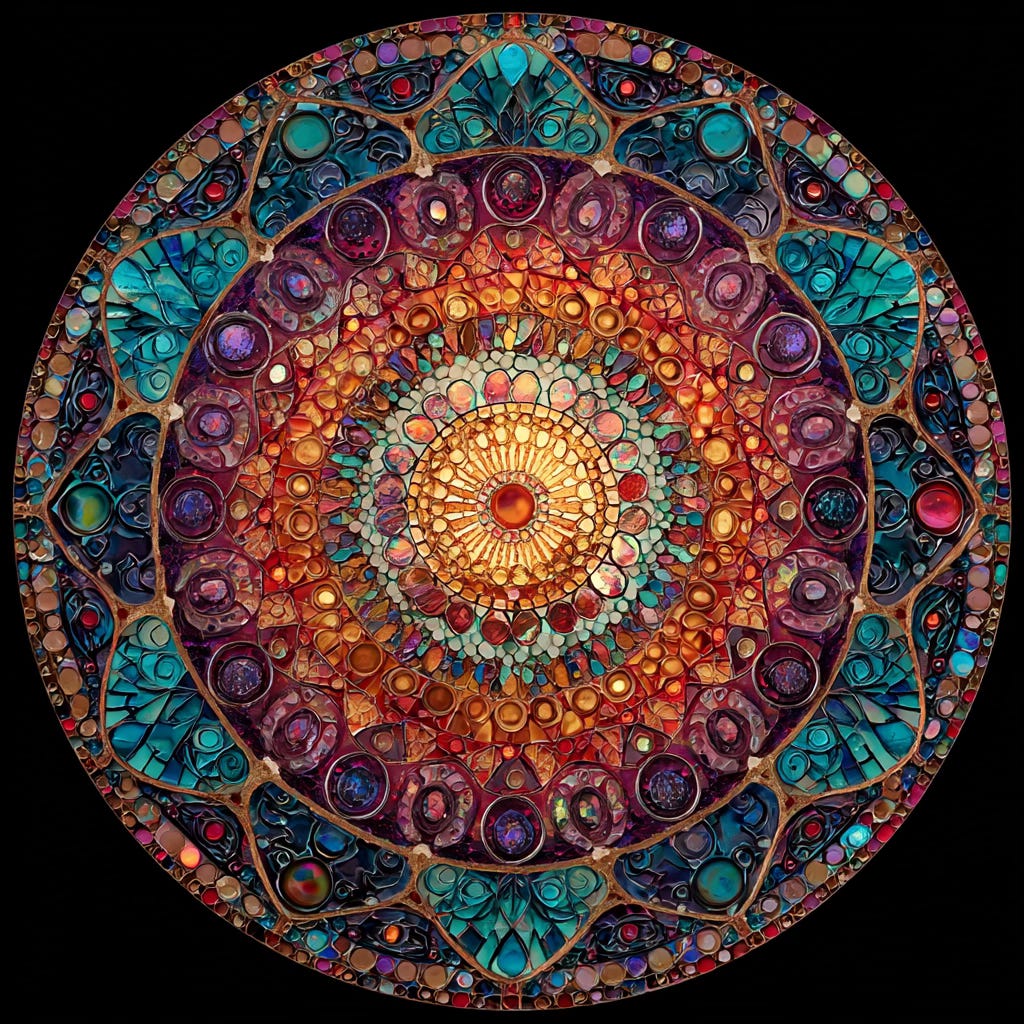
If you have ever held a kaleidoscope in your hands, you know that what you see inside it can be intricate, even mesmerizing. Small fragments of color and shape, ordinary on their own, are arranged into patterns that feel coherent, sometimes even beautiful. There is symmetry, repetition, a sense of internal logic that gives the image a kind of authority. It appears complete, as though it could only exist in that exact configuration.
And then, almost without effort, you turn the scope.
The fragments themselves do not change. The colors remain the same. The shapes are identical to what they were a moment before. But the pattern reorganizes instantly. A structure that felt fixed dissolves into something entirely different, and a new arrangement takes its place that equally coherent, equally convincing, and yet undeniably not the same.
What is striking is not only that the pattern changes, but that each version, in its moment, feels whole. Each one carries its own internal sense of rightness, as though it were the natural expression of what is there.
Life, as we experience it, often works in a similar way.
The Power of Patterns
We move through our lives forming patterns of meaning from the fragments of what we have lived, including experiences, relationships, moments of recognition or rupture, things that were given, and things that were missing. These elements do not arrive in neat sequences. They are not organized for our benefit. And yet, over time, they arrange themselves into interpretations that feel stable enough to rely on.
We begin to see ourselves through these patterns. We begin to anticipate others through them. We come to expect certain outcomes, to avoid certain risks, to move toward what feels familiar, even when that familiarity carries a quiet cost.
The patterns themselves are not arbitrary. They reflect an intelligence within us that is always trying to create coherence, to make sense of what has been lived in a way that allows us to continue moving forward. But the coherence they create is not the only one available.
What often goes unexamined is not the pattern itself, but the fact that we are inside it.
Stepping Outside the Pattern
There is a part of you that lives within the pattern, responding, interpreting, adapting in real time. This part is necessary. It is how you navigated your life as it unfolded. It carries your history, your instincts, your learned ways of making sense of the world.
But there is also another capacity within you that is not bound to that immediate experience in the same way.
It is the part of you that can step back, even slightly, and begin to notice what has been formed. Not to judge it or dismiss it, but to see it with a different kind of clarity. It can recognize that what feels fixed may, in fact, be a particular arrangement of meaning rather than the only possible one.
This is where something begins to open.
Because the moment you are able to see a pattern as a pattern, you are no longer entirely inside it.
You are in relationship to it.
When Meaning Begins to Shift
This does not mean that what you lived changes. The events remain what they were. The experiences you had are not erased or replaced. But the meaning that formed around them, the way those fragments were arranged into a coherent whole—begins to loosen, even if only slightly at first.
And when meaning begins to loosen, possibility begins to expand.
You may start to notice that what you once interpreted as limitation contained other dimensions you could not yet access. That what felt like a defining moment may have been one expression among many that could have emerged from the same conditions. That certain conclusions you drew about yourself, about others, and about what was or was not available to you, were shaped within a specific configuration of perception that is not the only one you are capable of holding.
This is not about replacing one interpretation with another more convenient one. It is about allowing your field of perception to widen so that more of what is true can come into view.
Seeing Patterns More Clearly
The power of patterns is not only that they organize our experience. It is that they quietly determine what we are able to see.
When a pattern is active, it filters perception in ways that feel seamless. Certain details stand out. Others recede. Some possibilities appear obvious, while others remain almost invisible, not because they are not there, but because they do not fit the pattern through which we are currently perceiving.
This is why two people can live through similar experiences and carry entirely different understandings of what those experiences mean. It is also why you, at different points in your own life, can look back at the same moment and see something new that was not accessible to you before.

The pattern did not simply store the memory. It shaped the meaning of it. When the pattern shifts, the meaning can shift with it.
Patterns Within Patterns
If you look closely at patterns, whether in nature, in the body, or even in the movement of thought itself, you begin to notice something else.
They are not flat. They are layered.
They repeat, but not in a simple way. They echo themselves across different scales, carrying a similar structure whether you are looking at something small and immediate or something larger and more complex.
This is what is known as a fractal.
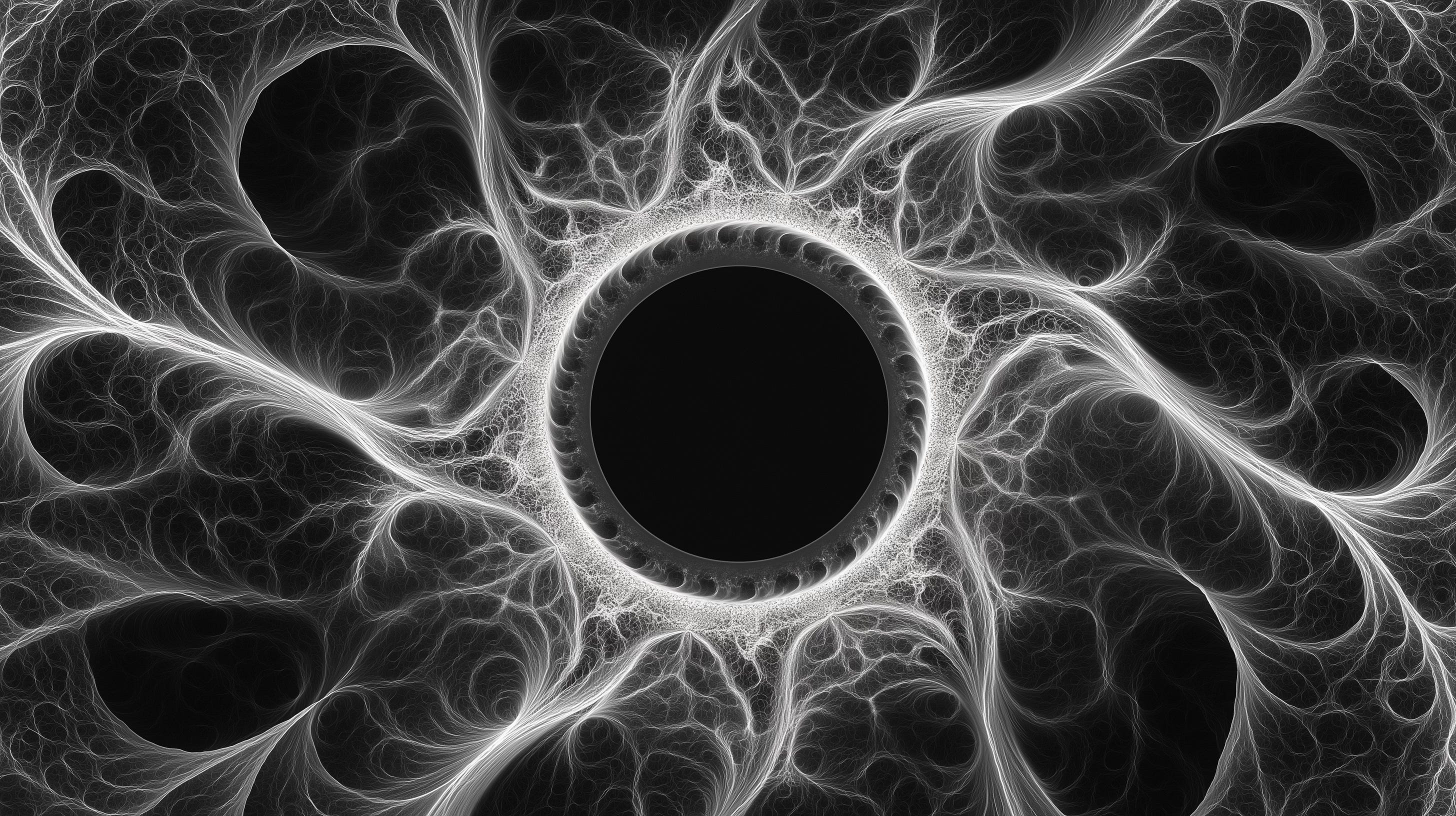
A fractal is a pattern that repeats itself within itself. The same structure appears again and again, at different levels, creating a sense of continuity that is both intricate and coherent. You can see this in the branching of trees, in the veins of a leaf, in the movement of coastlines, and even in the organization of the human brain.

What is striking is not just the repetition, but the familiarity of the structure across scale. And in many ways, our inner experience reflects this same principle. The way you respond in a single moment often carries the same shape as how you have responded across situations.
A hesitation in a conversation may echo a deeper pattern of self-protection.
A need to resolve tension quickly may reflect a longer history of managing instability.
A sense of anticipation of waiting for something to shift may not belong only to the present moment, but to a pattern that has repeated itself across time.
The pattern is not only in the event. It is in the structure of how meaning is formed.
This is why certain experiences feel so familiar, even when the details are different. You’re not simply encountering something new. You’re encountering a variation of a pattern that already exists within you.
And because it exists within you, it can recreate itself in different forms, subtly shaping perception, expectation, and response without needing to be consciously recognized.
But just as fractal patterns can reorganize when the conditions around them shift, so can the patterns through which you interpret your experience.
The structure is not fixed. It is dynamic.
And the moment you begin to see it, not just the surface expression, but the underlying shape—you begin to relate not only to the moment, but to the pattern itself. This is where your capacity to see differently becomes more than observation.
It becomes participation.
A Brief Note on the Brain
There is also a biological dimension to all of this that helps explain why patterns can feel so immediate, so convincing, and at times, so difficult to step outside of.
The brain is, at its core, a pattern-detecting and pattern-predicting organ. It is constantly taking in information, comparing it to what has been experienced before, and generating expectations about what is likely to happen next. Much of this happens below conscious awareness, and it happens quickly, often faster than deliberate thought.
This is part of what allows you to move through the world with efficiency. You do not need to relearn every situation from the beginning. The brain recognizes familiar signals, fills in gaps, and prepares the body to respond.
But this same efficiency is also why patterns can become so deeply embedded.
When a particular type of experience repeats, especially one that carries emotional intensity, the brain becomes more attuned to recognizing even subtle versions of it. It begins to anticipate, to predict, and to prepare the body accordingly. Neural pathways associated with those responses are used more often, and over time, they become easier to activate.
This is sometimes described as the brain becoming “wired” in a certain way not as a fixed condition, but as a reflection of what has been practiced, reinforced, and repeated.
The body is included in this process. The nervous system does not wait for full conscious interpretation before responding. It registers tone, expression, pace, and context, and can initiate a reaction before you have had time to think through what is actually happening.
This is why you may find yourself reacting first and understanding later.
And it is also why creating even a small pause, just enough to notice what is happening, can begin to interrupt the automatic continuation of a pattern.
Because while the brain is shaped by repetition, it is also capable of change.
New patterns can form. Different associations can be made.
And over time, the way you interpret and respond to your experience can begin to reorganize, not through force, but through awareness, attention, and repeated moments of seeing differently.
This is not separate from the patterns we have been describing. It is one of the ways they are formed, and one of the ways they can shift.
The First Movement
It is from this place that a different kind of engagement with your own life becomes possible. Not an effort to control or overwrite your experience, but a willingness to become more aware of how meaning is being formed, and how it might be seen differently. This is a quieter process than we often imagine. It does not require force. It begins with the simple, but not always easy, act of noticing.
Noticing when something feels fixed.
Noticing when an interpretation feels automatic.
Noticing when a reaction seems inevitable.
These are often the moments when you are most fully inside a pattern that has not yet been seen.
The KaleidoProcess
What I came to understand, over time, is that this capacity to notice, to step back, and to allow a different arrangement of meaning to emerge is not incidental. It is a distinct way of engaging with your own experience, and it can be cultivated.
It’s what I now think of as a process - one that unfolds not in a straight line, but in movements that echo what you might recognize from the turning of a kaleidoscope. There is a pause, where something interrupts the automatic continuity of experience.
There’s an inquiry, where you begin to look more closely at what is being assumed, interpreted, or concluded.
There’s a shift, often subtle at first, where the pattern begins to reorganize.
And there is a reset, where what once felt fixed gives way to a different sense of coherence.
I call this the KaleidoProcess - because that observing Self within you gets to turn the lens to shift and reveal a change in the noticed pattern.
An Opening, Not a Conclusion
You do not have to apply it all at once. You do not have to revisit every part of your past or attempt to resolve everything that has ever felt unclear or unfinished.
It begins much more simply than that. With the recognition that you are not only the one who lived your life. You are also the one who can see it. In that seeing, even in its earliest stages, something begins to change. It’s not what has been, but what becomes possible from here.
A Simple Practice You Can Use Now
There is a way to begin engaging this capacity immediately, without needing to prepare or set aside a large block of time. It can happen in the middle of an ordinary moment. The next time you notice a reaction that feels quick, familiar, or slightly disproportionate to what is in front of you, allow yourself a brief pause - not to stop the reaction, but to include it in your awareness.
Let your attention move, even slightly, from the situation itself to what is happening within you.
You might notice a tightening in the body, a shift in breath, a familiar line of thought beginning to form, or a sense of anticipation that something is about to unfold in a certain way.
Without trying to change any of it, ask yourself a simple question:
What am I assuming is happening right now?
Stay with whatever arises, without rushing to answer it perfectly. Often, the first layer will be close to the surface. Beneath it, there may be something more subtle - an expectation, a remembered pattern, a sense of what usually follows.
Then, gently widen the frame:
What else could also be true?
This is not an exercise in optimism. It is an opening of perception. You are allowing more than one arrangement of meaning to exist at the same time.
If it feels available, take one small step that reflects this widened view. It may be as simple as waiting a moment longer before responding, asking a clarifying question, or allowing the situation to unfold without immediately resolving it.
Nothing dramatic is required.
What matters is the shift from being fully inside the pattern to beginning to relate to it.
Over time, these small moments accumulate. They create space. Within that space, different patterns begin to emerge - patterns that are not driven solely by what has been, but are responsive to what is here now.

In the Next Post
We will look more closely at the part of you that makes this possible.
The aspect of your awareness that can observe without collapsing into reaction, that can hold multiple perspectives at once, and that can begin to reorganize meaning in a way that is both grounded and expansive.
You may already have a sense of it from your own experience. It’s the moment you pause and something in you becomes quietly attentive rather than immediately reactive.
Because once you can recognize it, you can begin to rely on it…and that is where a deeper kind of shift begins.
In Flow with You,
Angelique

David, I am interested by your own insights about navigating a personal memoir --the dance between the prior self and present self conveying your one lived experience. Stay in touch on this!
Extraordinary reflections, Angelique. Fractal reflections themselves.
I thank you for enhancing my 'flow'. I will be revisiting my memoire incorporating your insights.