
The Jazz Cruise Effect
When Music, Memory, and Belonging Reawaken the Self

There are vacations.
And then there are magical immersions.
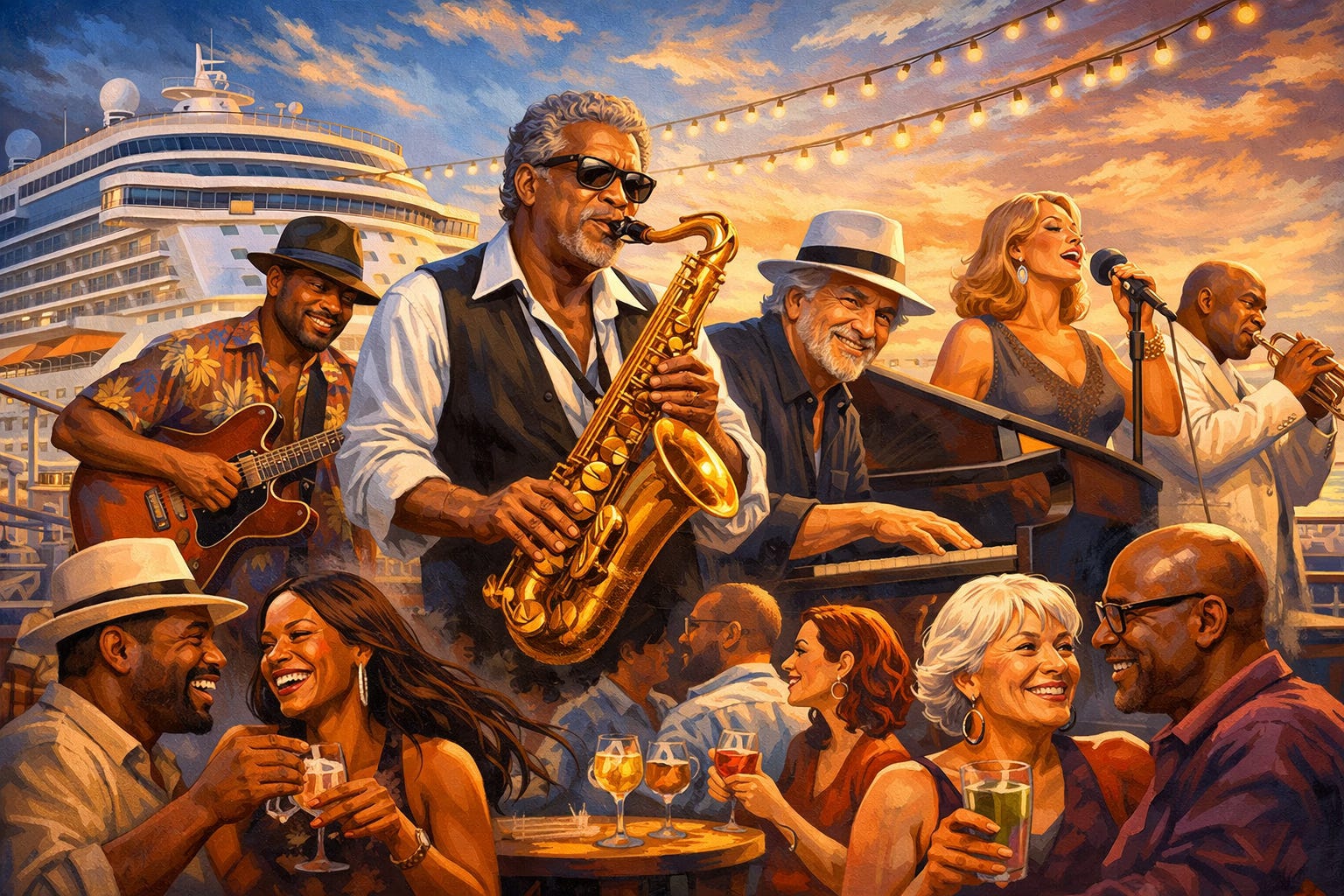
On this recent 7-day Smooth Jazz Cruise — produced by the Signature Jazz Cruise Experience — we weren’t simply entertained; we were saturated. Up to 12 hours of live performance daily. Multiple stages unfolding simultaneously. Legendary headliners backed by three extraordinary house bands who themselves rotated into the spotlight. You could move from one deck to another and encounter an entirely different emotional temperature — sultry guitar on one end of the ship, explosive horn sections on the other, a keyboard solo cascading through open air as the ocean stretched endlessly beyond.
Kenny G’s unmistakable soprano tone floated across the water like silk. Keiko Matsui’s piano phrasing shimmered — lyrical, precise, reverent. Peter White’s guitar carried warmth and elegance. Jonathan Butler brought gospel fire and soul. Brian Culbertson danced effortlessly and bemusedly emoted on his keyboard, his energy both polished and playful. Marcus Miller’s bass was architecture — groove as foundation. Boney James bent notes with that familiar sensual phrasing that defined entire decades.
And behind them — around them — the bands. The drummers who held everything steady yet alive. The percussionists adding texture and lift. The keyboardists layering harmony. The horn players who could step forward at any moment and electrify the air. Faces lit up mid-phrase. Eyes closed in concentration. Smiles breaking open when a solo landed just right.
This was not background music.
It lived in the body.
Fingers snap without instruction.
Feet tap in unison beside one another.
Shoulders sway.
Couples lean closer.
Solo travelers rock gently in their seats.
Some rise and dance. Others close their eyes and let the groove move through them.
The motor cortex activates even before conscious choice. Rhythm entrains breath and heart rate. Neural oscillations synchronize with the beat. Dopamine rises as improvisation dances between tension and release. Oxytocin increases as we watch musicians cue each other with a nod, a smile, a raised brow mid-solo.
Jazz is collaborative risk. And the nervous system responds to it.
Lineage in the Blood
For me, this immersion carried another layer.
I was absorbed into the jazz “club” as a child — long before I understood what that meant. Jazz was not just a genre of music in our family. It was inheritance.
I am the granddaughter of Clarence Williams and Eva Taylor, pioneers and icons of early jazz. Clarence, a prolific composer and publisher who helped shape the soundscape of the 1920s and 30s, giving countless performers opportunities on records he produced. Eva, a celebrated vocalist whose phrasing carried both sophistication and soul. I did not fully grasp their contribution until decades after their deaths. But I knew, even as a little girl, that jazz was special. It carried texture. Depth. A kind of coded elegance.
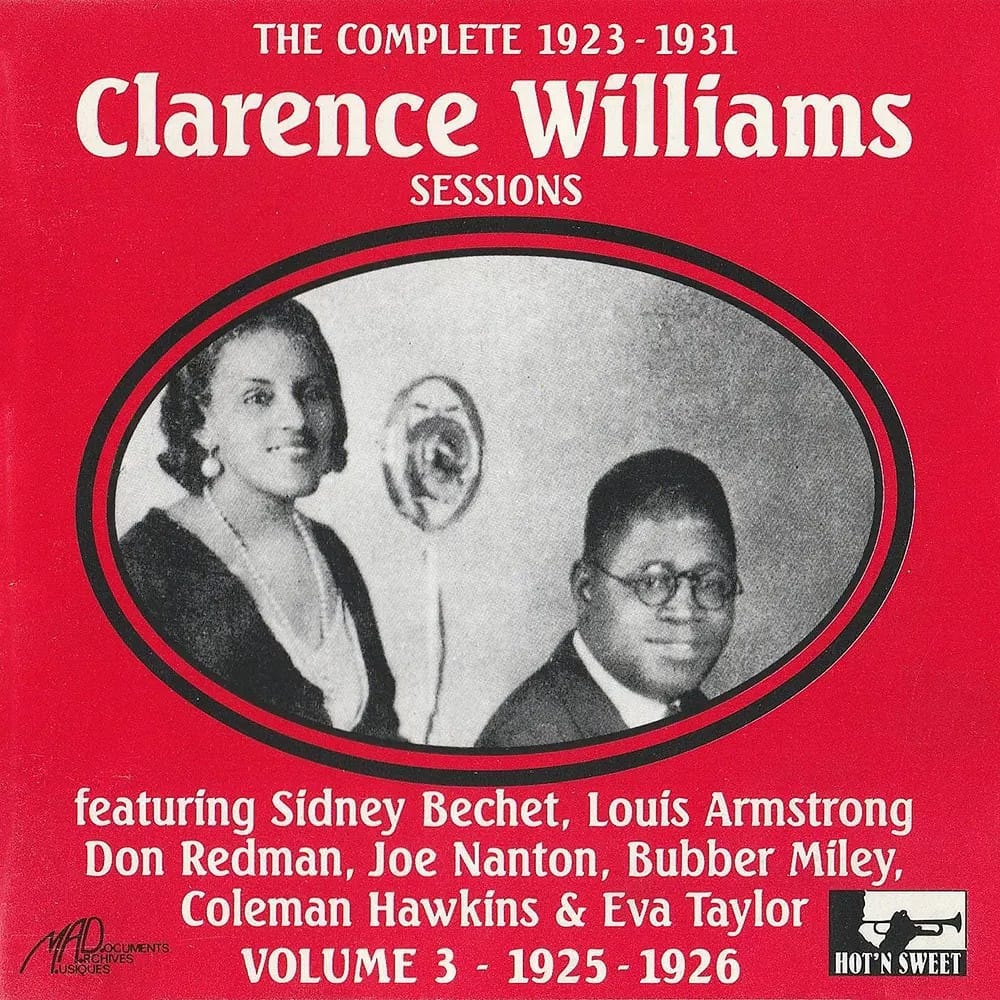
My mother died suddenly as I turned 14. Jazz became the bridge between my father and me that enabled us to re-bond as a restructured family. My dad, Bill Matney, started his journalism career as a newspaper editor in Detroit. He was also a passionate jazz aficionado who, for a time, co-ran a jazz record distribution business with a fellow jazz lover as a side-line in the 1960s. Albums proliferated several shelves in our homes. Music was our shared language when grief hovered but went unnamed. Conversations between us addressed phrasing, beat and tone. We listened as ritual. During my college breaks, we would exchange and devour each other’s cassette tapes. I introduced him to Smooth Jazz; he deepened my appreciation for Bill Evans, Miles Davis, Oscar Peterson and many other “straight-up” jazz greats. Jazz became our way of staying close — a continuing, engaged conversation that did not require explanation. The sounds created their own wavelengths of appreciation and understanding between us.
In my much later years, I traveled and attended regularly the annual Detroit Jazz Festival with other close family members — where we enjoyed our reunions and the amazing music at what is the largest free open-air jazz festival in the world.
The Neuroscience of Jazz
Neuroscience now tells us what we intuitively lived: music bundles memory, place, and person into tightly woven neural networks. The hippocampus encodes autobiographical moments; the amygdala tags them with emotional intensity. When we hear music tied to formative years, those networks reactivate almost instantly.
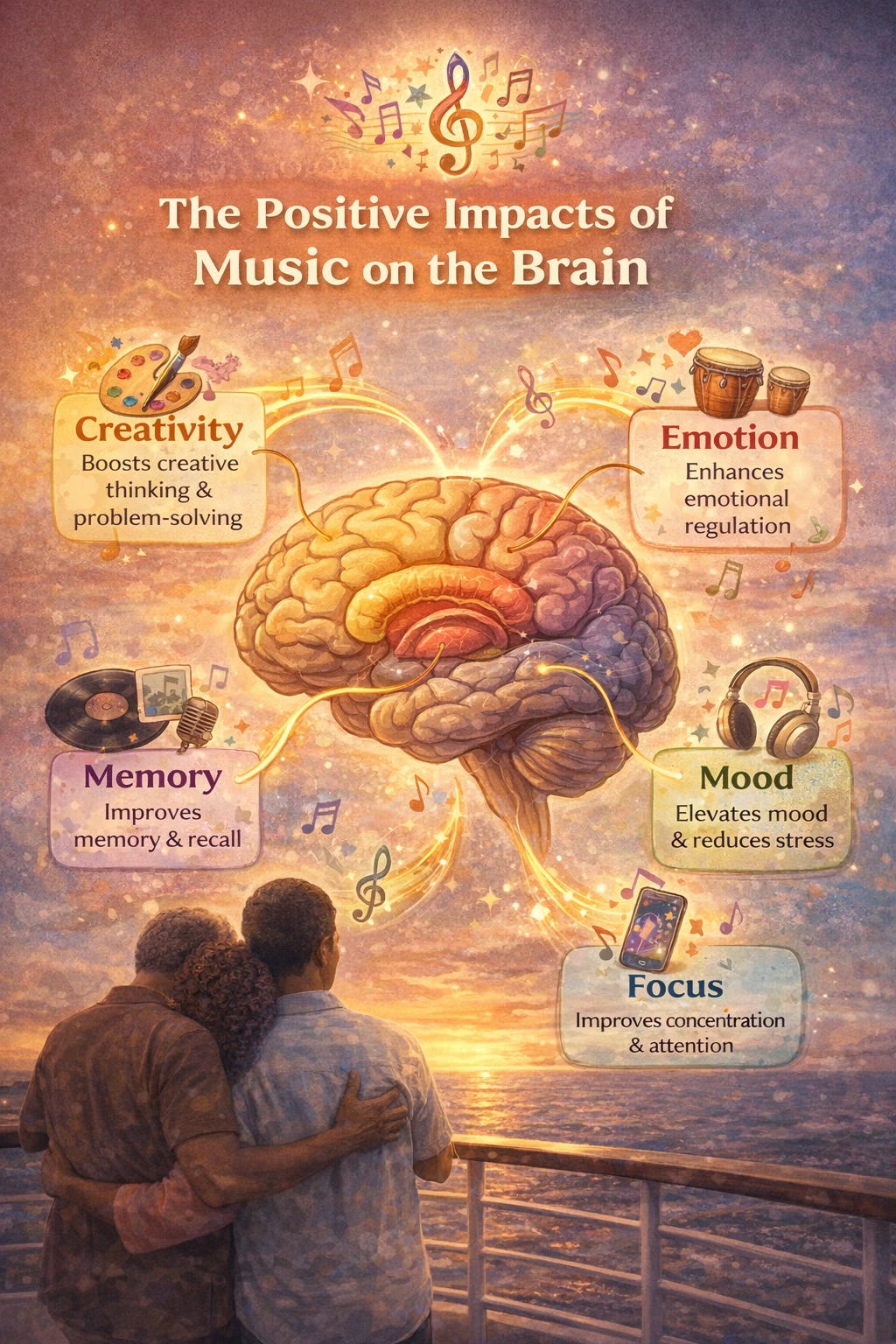
But whether that reactivation feels like ache or appreciation depends on integration.
On this cruise, when the music of my 20s, 30s, and 40s filled the air, I didn’t feel pulled backward in time. I felt widened.
The younger woman who once swayed to these rhythms was not a ghost. She was present. Not as longing. Not as regret. As continuity.
It was celebration, not nostalgia.
I found myself rebuilding my own smooth jazz playlists in real time — song after song triggering another memory, another season, another chapter of becoming. Not to relive them. To honor them. To recognize the through-line that carried me here.
Why Jazz Is Different
All music activates reward circuits. But jazz engages the brain in distinct ways.
Improvisation requires constant prediction and recalibration. Brain imaging studies show that during improvisation, areas associated with self-monitoring quiet down while regions linked to spontaneous creativity activate. Jazz trains the nervous system to tolerate ambiguity and delight in surprise.
Unlike rigidly structured genres, jazz thrives on conversation.
Call and response.
Solo and support.
Structure and freedom.
Mathematics made sensual.
Smooth jazz, in particular, is fusion art. It braids R&B sensuality, funk groove, gospel uplift, blues depth, and traditional jazz sophistication. Vocals self-express in daring ways. Horns lift and declare. Percussion drives and teases. Keyboards layer atmosphere. Electric guitar bends emotion into sound. Occasional strings add cinematic sweetness.
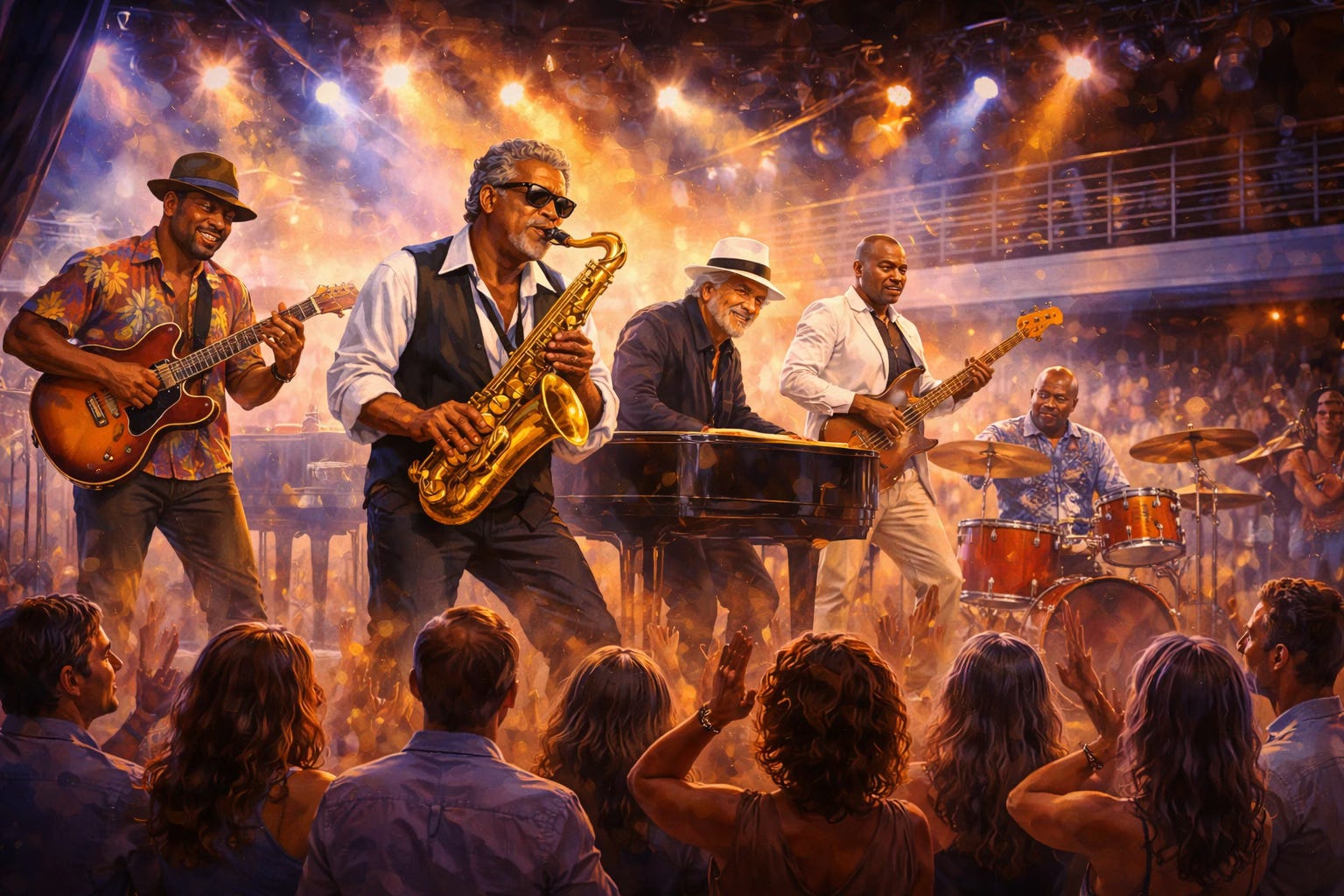
It is sophisticated without being brittle. Sensual without being shallow.
Structured without being rigid.
Our mirrored neurons light up as musicians exchange glances and cues. We feel the trust required to step forward into a solo and the generosity required to step back into support.
Jazz models relational intelligence.
It’s not accidental that so many couples were swaying on that ship. Shared rhythm synchronizes physiology. Heart rates align. Breathing entrains. Oxytocin rises.
But what fascinated me most was this: through the chats I had with others on the ship, I estimated that well over 70% of attendees return to the jazz cruise — some every year, and some annually over the last 10 years. They tell their friends and relatives and then they come along the following year. The demand is so great that additional cruises are added each year and the next year’s cruise becomes nearly sold out before debarking.
That isn’t casual fandom. That is ritual belonging.
Extended immersion in live jazz lowers cortisol, enhances dopamine baseline, strengthens vagal tone, and increases oxytocin through shared synchrony. But beyond the biology, it reinforces identity.
Jazz listeners often feel like members of a quiet society. You have to listen closely. You have to appreciate nuance. You have to enjoy unpredictability. There’s a subtle signaling among those who “get it.”
I met a solo traveler who has come alone for more than a decade because none of her friends love jazz the way she does. She comes anyway.
Because she knows who she becomes inside that soundscape.
Jazz reveals you to yourself.
Jazz as Origin and Bridge
There is another dimension that moved me deeply.
Jazz and blues emerged from the African-American experience — from blues, spirituals, work songs, gospel, sorrow, joy-making, syncopated rhythms, honky tonk and brilliance forged under constraint. They are not abstract art forms; they are cultural inheritance. We know who those early masters of the horn and keyboard are.
Smooth jazz carries those rivers forward.
On this cruise, the audience was predominantly Black — far more than on other cruises I’ve taken — and that mattered. Many of us, especially my own peers, grew up with this music not as novelty but as atmosphere. It was in our homes. At family gatherings. In the cars. In the background of memory.
And yet, what struck me just as strongly was the absence of divide.
On stage and in the audience, there was mixture.
Different races.
Different ages.
Different backgrounds.
What unified everyone was shared attunement.
Jazz has long been embraced across racial lines. It has been studied, adopted, expanded, and honored by musicians and audiences around the world. It is one of America’s great original art forms.
But it never forgets its origin.
That duality — rooted and expansive — may be part of its regulating power.
Jazz models integration. It doesn’t erase difference. It harmonizes it.
Call and response across cultures.
Improvisation within shared structure.
Solos rising from collective groove.
In a world so often fragmented along racial lines, jazz remains a space where collaboration is the point.
Belonging without erasure.
Heritage without exclusion.
Complexity without division.
Jazz does not flatten difference. It orchestrates it.
Re-harmonizing
On that ship, surrounded by smiling musicians whose faces lit up mid-phrase, by stories of decades in craft, by hallways where we could pass them in elevators and simply say thank you, by lineage and collaboration and joy braided together — I did not relive my past.
I re-harmonized with it.
The groove continues.
And so do we.
Love (that Jazz),
Angelique
P.S. Check out my new book: Unlock Your Potential with the EnteleKeys and take the free EnteleKeys assessment. Thank you for visiting!
How you riff, Angelique! You are both magician and shaman. Thank you for bringing good medicine and warm vibes. You are a musician with words. Shante, shante!
I am delighted that you could go on another cruise—and I love the way you describe the power of Jazz. It was not part of my background, but you open a door to appreciating it even more. And I love how jazz connects you both with your family legacy, African-American culture, and your own joy. Just wonderful to read!