
The Evolving Order Beneath: Why No One Escapes an Uneven Beginning
And why FLOW asks something more of us.


The Human Condition: Shaped by Contrast
To be human is to be shaped by contrasts. We do not arrive into symmetry. We arrive into variation, into difference, into conditions that both nourish and limit us.
Not by perfection, nor by uninterrupted streams of love, safety, and attunement, but by something far more textured—an interplay of warmth and withdrawal, presence and absence, recognition and misattunement.
We are formed in environments that are, by their very nature, uneven, imbalanced or even highly polarized — with the so-called “good” and “bad.”
The Spectrum of Unevenness
And it is important to say this with care: the spectrum of that unevenness is vast.
For some, it reflects ordinary gaps in attention, attunement, or understanding. For others, it includes profound disruption—experiences of neglect, harm, instability, or environments shaped by fear, volatility, or absence. These are not equivalent, and they do not leave the same imprint.
There are lives shaped by deep and lasting trauma, by emotional and psychological fragmentation, by patterns formed in conditions no child could comprehend or control.
We are all, in our own ways, born into stories we did not author and could not yet understand.
We are Patterned Before We Are Aware
What follows is not meant to diminish those realities, nor to collapse their differences, but to recognize something that remains true across them: we are shaped before we are aware, patterned before we can choose.
Even the most loving caregivers cannot meet every moment, every need, every nuance of who we are becoming. They, too, are shaped by inheritances of love and fear, clarity and confusion, presence and limitation. What they offer is real—but it is never total.
So we arrive here—each of us—not as blank slates, but as patterned beings.
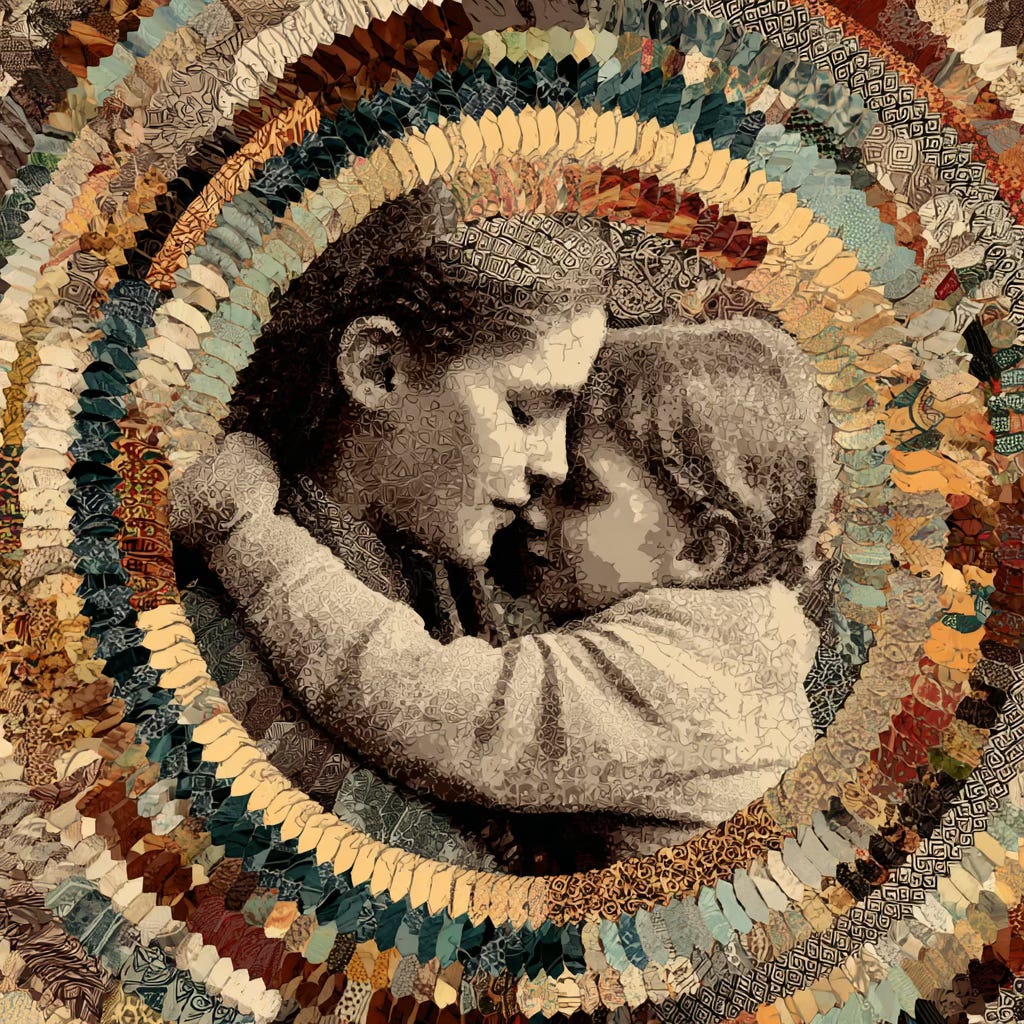
Responsive. Adaptive. Quietly brilliant in the ways we learned to secure belonging, avoid pain, make meaning, and stay safe.
This Is Not Dysfunction. This Is Design.
There is nothing inherently wrong with this. It is, in fact, the intelligence of the human system. Your nervous system learned. Your mind interpreted. Your emotional world organized itself around what was available—and what was not.
You learned what to move toward and what to avoid, what invited connection and what risked disconnection. You learned how to be.
This is NOT dysfunction. This is design.
We are not broken by the fact that we adapted. We are shaped by it.
The Residue of What Was Missing
And yet, because these patterns were formed in moments where something felt missing, confusing, or overwhelming, they often carry a kind of residue—a sensitivity, a vigilance, a subtle sense that something should have been different.
So the human impulse arises, almost inevitably, to look back, to locate cause, to assign responsibility.
To say, in one form or another: if “that” had been different, I would be different.
This, too, is human.
The Function—and Limitation—of Blame
Blame is not a failure of character. It is an attempt to restore coherence, to make sense of why something feels the way it does.
But what begins as an attempt to understand can, over time, become a way of staying bound.
A Radical Recognition
But there comes a moment—sometimes gradual, sometimes sudden—when a deeper recognition begins to take shape.
There is no human life that is not shaped by significant imbalance. Unevenness is not the exception to the human experience. It is the condition.
No one escapes the spectrum. No one is formed in uninterrupted coherence.
The Question Begins to Shift
And from this recognition, something quietly radical becomes available. If unevenness is not a personal failure, if it is not a singular injustice visited only upon you, but a shared condition of being human, then the question begins to shift.
From: Why did this happen to me?
To: Given that this is part of being human… what is now mine to do?
The Threshold of FLOW
This is the threshold where awareness turns.
Not away from the past, but away from the expectation that the past must be different in order for you to become whole.
FLOW is not the denial of what shaped you. It is not the erasure of imprint, nor the dismissal of pain. It is something far more precise—and far more powerful.
It is the willingness to move forward without requiring a different past to justify a different future.
A Different Relationship to the Past
A different future does not require a different past. It requires a different relationship to what has been.
This is not automatic. It is, in a very real sense, transcendental. Because it asks you to do something the patterned self does not naturally do:
To release the orientation that says,
I am the result of what has happened, and to step into something more generative— I am also the author of what becomes possible from here.
The Movement Toward Coherence
This does not happen in a single moment. It unfolds through awareness—through noticing the patterns that still shape your responses, through recognizing where the past is still speaking as if it were present.
Gradually, through choosing again and again to meet your life from a place that is not entirely governed by what was.
This is the movement toward coherence.
Coherence is not the absence of what has shaped you. It is your capacity to meet it differently.
What FLOW Truly Means
Not perfection. Not purity. Rather, it’s a growing alignment between Who You Are, What You Have Lived, and How You Choose to Engage Life NOW.
FLOW means NOT to have had a perfect beginning. It is to no longer require one.
Where FLOW Deepens
Yet, this is only the threshold. Because something even more powerful begins to emerge when you recognize that the past is not only something that shaped you—it is something that can be re-seen, re-held, and re-interpreted from a different place within you.
There is a part of you that is not bound to the moment in which the pattern was formed. A part that can pause, observe, inquire—and offer a different meaning, a different response, a different possibility.
The Opening
When you begin to rest there, something shifts. The past loosens its grip. The present becomes more available— and the future is no longer an extension of what has been, but an opening into what can be created.
What Comes Next
This is where FLOW begins to deepen. Not simply as forward motion, but as a living dialogue between what you have lived and what you are now capable of seeing, choosing, and becoming.

In the next exploratory FLOW post, we will turn toward this more directly:
How the part of you that can see differently can begin to reframe what has been—and, in doing so, liberate what becomes possible.
Thanks for spending time here.
In FLOW with you,
Angelique
