
The Creator’s Inner Economy
Actualizing Abundance Through Your Native Energy


I am starting a new series of essays. As I’ve been posting essays on Substack regularly for over a year (for the sheer love of it), I’ve also explored with curiosity the many offers on Substack about how to grow, make money and thrive. I’ve even invested in a few programs, labs and cheat sheet how-to’s which tout all the things we should do to grow our Subtacks.
In one program, one thing I noticed…that it wasn’t learning all the how-to steps that immobilized some, or even most who asked questions. It was about how to proceed with some kind of innate understanding and inner confidence that they had something of value to offer. This seemed to stymy some participants who were there to learn how to create abundance on the platform and elsewhere. My intuition read that they seemed to lack certain clarity and confidence, and without those elements in place, also a “go-get-it” courage. Hard to say “they” because as a retired professional seeking a new avenue of self-expression and abundance, I’ve experienced this too.
So, I’ve decided to take what I’ve learned, intuited and experienced on this issue and share my own thoughts about a way to navigate — in this ever-changing sea of work and technology changes — the path to abundance. This is one of those “Aches” I write about in other articles, including the longing we all have to be abundant and free.
I invite your engagement on this topic. What’s going on for you?
The Sovereign Economy Within You
Most of us were taught how to prepare for work. We learned how to earn credentials, describe our experience, perform a role, and make ourselves useful inside structures someone else had already built. When someone asked, “What do you do?” we answered with the name of a profession, a position, a company, or a field.
What many of us were never taught was how to understand the source of value beneath all of that. We may know the jobs we’ve held and the responsibilities we’ve carried, and we can usually explain what we made, managed, taught, sold, organized, or delivered. Yet when the role changes, the work disappears, or we begin wanting something more self-directed, a deeper uncertainty can surface.
What do I actually have to offer? What could I create that another person would value? How would I know whether one of my ideas could become something sustainable?
When the Old Paths No Longer Feel Secure
We are moving through a profound change in how people understand work, security, and their own economic value. For generations, the expected path was fairly clear. You prepared yourself for a profession, found a place inside an institution, developed your expertise, and trusted that your work would continue to provide some measure of stability. That arrangement was never equally available to everyone, nor was it ever completely secure. Still, it gave many people an external structure through which they could imagine supporting themselves and their families.
That structure is becoming less reliable.
Entire fields are being reorganized. Roles that once required years of experience are being narrowed, combined, outsourced, or automated. Artificial intelligence is moving rapidly into work that people once believed depended upon distinctly human intelligence. Writers, designers, lawyers, teachers, consultants, analysts, artists and other knowledge workers are watching machines perform tasks that once helped define their professional value.
It’s difficult to witness this without asking a more personal question: What remains valuable in me when a function I perform can be done faster, more cheaply, or at greater scale by a machine?
This reaches far beyond career planning. We all need and want some form of abundance. We want to support ourselves, care for the people we love, make choices with greater freedom and build lives that aren’t governed by constant economic fear. Most people can’t afford to treat the changing employment landscape as an abstract conversation about technology.
Yet the external models we once relied upon are beginning to fall away before clear new ones have taken their place. This doesn’t mean that everyone must become an entrepreneur. Employment will continue and people will still work inside companies, schools, hospitals, institutions, governments and organizations of every kind. Whether we remain employed, create something of our own or move between several forms of work, we’ll need a more conscious relationship with the value we bring.

A job title is no longer enough. A résumé can describe where we’ve been, but it may say little about the human source beneath what we’ve done. Even technical skill, by itself, may not provide the security it once appeared to promise.
We need to understand the inner engine beneath our work.
What do we see that others miss? What do we bring to a problem, a relationship, or a body of work that changes what becomes possible? How does our particular energy become useful to other people, and how can we learn to express that value in ways they can recognize?
This inner source is the common denominator on any future path of abundance.
We’ll have to do more than privately believe that we have value. We’ll need to embody it, so that it’s present in the way we work and make decisions. We’ll need to express it through forms that allow others to experience it. We’ll also need language that makes clear what our contribution can offer.

The outer form may be a job, a business, a collaboration, a creative offering, or something that hasn’t yet been invented. The pathway begins in the same place: with a fuller recognition of the human value we already carry and a willingness to give it form
.In this atmosphere of uncertainty, it’s understandable that people are searching urgently for a new path. The advice arrives from every direction. Choose a niche. Define your ideal customer. Build a funnel. Grow your list. Post more often. Package your expertise. Develop a signature offer. Use AI to produce more in less time.
Some of this is useful. Practical knowledge matters. We do need to understand how people find us and what helps an idea become something another person can actually use. But there’s a danger in beginning there.
We can become highly educated about how other people built their businesses while growing less certain about what we ourselves are here to build. We begin measuring our instincts against someone else’s method. If the method doesn’t fit, we assume the problem is our discipline, our confidence, or our willingness to do the work.
Sometimes the problem isn’t that we failed to follow the formula. Sometimes the formula was never designed around the way we naturally create value.
A person can follow every recommended step and still end up working inside something that drains her. She can become visible without feeling recognizable. She can build an offer that looks polished from the outside, yet somehow doesn’t carry enough of her to feel alive. This is why I believe creators need to understand their inner economy before they rush to construct an outer one.
Before You Reach for Another Formula
In the middle of all this noise, it may be worth pausing before you absorb one more strategy for how to build an audience, create an offer, grow a business, or turn your ideas into income.

What happens inside you when you encounter another person’s confident formula for creating abundance? Do you feel encouraged, or do you quietly begin doubting your own instincts?
Do you start comparing yourself and your sensibilities to those of the guide, and feel you fall short?
Have you become more informed about how other people work while growing less certain about what is genuinely yours to create?
Are you building from a clear understanding of the value you carry, or are you still hoping the right business model will reveal that value to you?
When you imagine earning in a more self-directed way, what do you believe people would actually come to you for? Is your answer based on a title or skill, or can you name what becomes different because of the way you bring that skill to life?
What have people consistently trusted you to see, clarify, create, restore, organize, or make possible, even when it wasn’t written into your job description?
Which parts of your contribution have you dismissed because they feel too natural to count as expertise?
Have you ever followed a promising strategy only to discover that the way it required you to work, communicate, or remain visible didn’t feel like you?
Are you spending more energy studying how to create abundance than allowing yourself to test one expression of your own value in the world?
And beneath all of that, perhaps the most important question is this: if the familiar structures around work continue to change, what remains in you that can still become useful, recognizable, and capable of creating exchange?
These aren’t questions with quick answers. They ask us to look beneath the form our work has taken and become more conscious of the inner source from which new forms might emerge.
What Is Your Inner Economy?
Your inner economy is the full body of human value you already carry and the living source from which you can continue to create.

It includes what you know, but it’s larger than knowledge. It includes your skills, although it can’t be reduced to a résumé. It also lives in the way you see, the distinctions you make, the problems and issues you instinctively notice, and what tends to happen when you become deeply engaged.
It is the particular way your energy becomes useful and contributing.
Some people enter confusion and begin creating order. Others can hear what someone is trying to say before the words have fully formed. One person notices possibility where everyone else sees limitation. Another senses where something has lost coherence and knows how to bring it back into balance.
These capacities often become so familiar to us that we stop recognizing them as value. Because they come naturally, we assume they must be ordinary. We may even believe that real work should feel harder than the thing we instinctively know how to do.
An employer may have paid for one application of that capacity. A job may have given it a title and a set of responsibilities, but the job didn’t create it. The institution doesn’t own the way you think. The platform doesn’t own your voice. The client doesn’t own your ability to perceive what matters.
These capacities belong to you. They are part of the sovereign economy within you.
Sovereignty, in this context, doesn’t mean you have to reject employment or build a business alone. It means that no employer, audience, marketplace, or algorithm becomes the final authority on whether you carry value. You may express that value through a job. At another point, it may move through consulting, teaching, writing, products, performance, advising, or a form that doesn’t yet have a familiar name.
The vessel can change. The deeper source travels with you.
The Role Is Not the Whole Story
This is especially important for people who have spent years inside established professions —like me. Many of us become fluent in describing our duties without ever learning how to name what we repeatedly made possible.
You might say that you managed a department, but perhaps what you really did was recognize talent and help people work through conflict without losing sight of the larger purpose. You might say that you practiced law, as I did. Yet, the deeper value was my ability to see the structure beneath a complicated situation, anticipate where risk would emerge, and create agreements that allowed something viable to move forward.
You might say that you taught. The part people remember, however, may be that you made difficult ideas feel accessible. You restored confidence in people who had quietly concluded they weren’t capable of learning. The role matters because it gave your contribution somewhere to live, but it isn’t the whole story.
When we don’t understand that distinction, a disruption in our work can feel like the disappearance of our value. We ask what job we can still get or what business we could possibly start. We don’t always stop long enough to examine the deeper pattern of contribution that has been present all along.
The same confusion can arise among creators. A writer may believe her value lies in producing essays. An artist may believe it lies in making images. A coach may locate it in the session she delivers, while a consultant may see it in the recommendations she provides.
Those are expressions of value. They aren’t necessarily the source.

Compare those expressions to these: The writer may help people perceive their lives differently. The artist may restore a feeling of beauty, mystery, or belonging. The coach may recognize the hidden belief beneath a repeated pattern. The consultant may see the decision a company has been avoiding.
When we confuse the form with the source, every change in the form becomes threatening. If a platform stops working for us, we feel stranded. If AI can perform part of the task, we fear that the whole of our contribution has been erased. If one product doesn’t sell, we may decide that nothing we carry has economic value.
What AI Is Asking Us to Understand
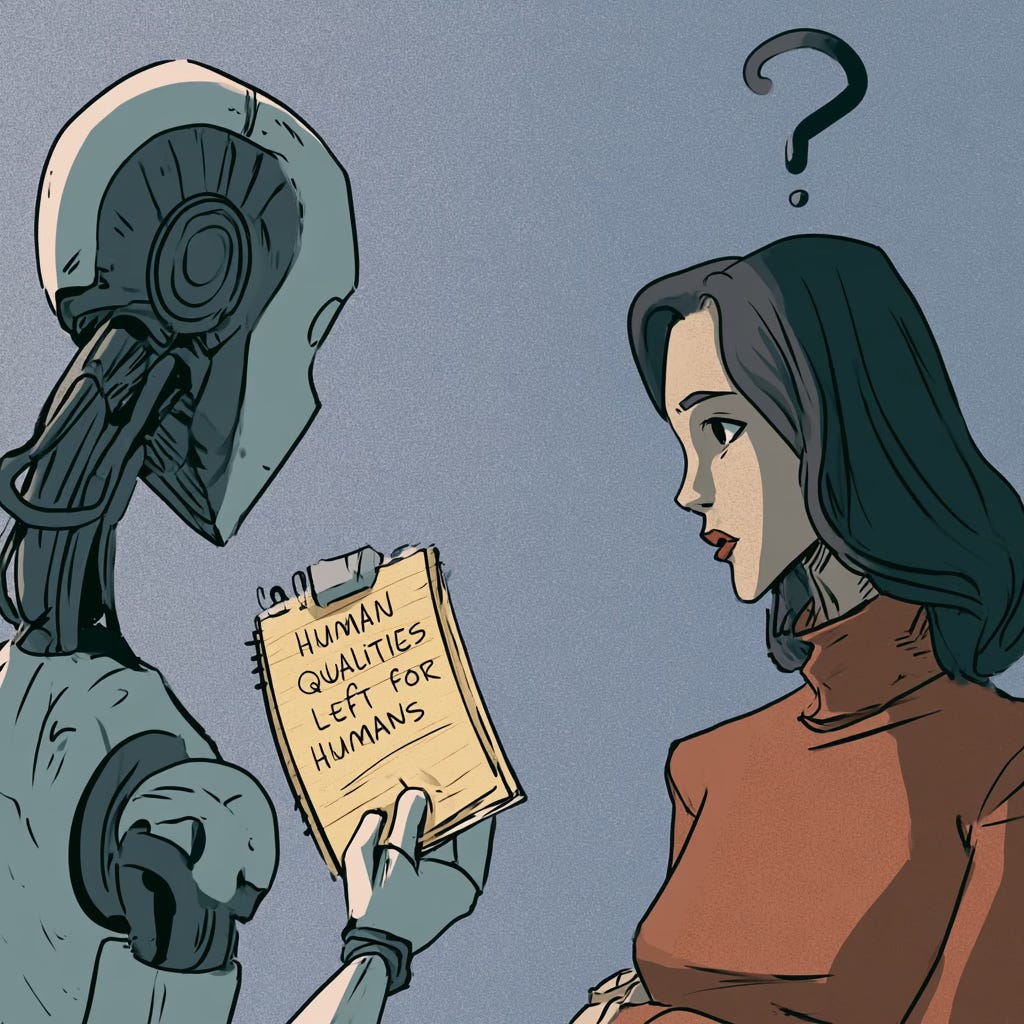
Artificial intelligence is forcing us to become more precise about human contribution. It can already perform many of the functions that once helped define a person’s professional value. Pretending otherwise won’t help us understand what remains distinctly ours.
The more useful question isn’t whether a machine can perform part of what you do.
It’s whether you understand what you bring that gives the work direction, judgment, meaning or human consequence.
AI may produce twenty possible brand identities, but it can’t independently know which one carries integrity for the person behind the brand. It may summarize a body of information, but it doesn’t decide which question deserves to guide the inquiry. It may generate a polished plan without living with the emotional or relational consequences of the choice.
AI can imitate a voice, but it cannot possess the life that made the voice necessary.
The challenge before creators isn’t simply to insist that we’re irreplaceable. Some functions will be replaced. The deeper task is to stop confusing ourselves with the functions.
That calls for a more grounded relationship with value. Many people say they want to create abundance, but they still experience abundance as something that must be granted from outside. They wait for an employer to recognize them, an audience to grow, a client to say yes, or a publisher to approve the work.
External response matters. We can’t build an economy without exchange. When we have no steady understanding of what we bring, every response becomes a referendum on our worth. A disappointing launch means we have nothing to offer. A small audience means the work doesn’t matter. One failed proposal can make the whole idea feel foolish.
An Inner Economy gives us another place to stand. It allows us to examine what happened without abandoning the source. Perhaps the offer was unclear. Maybe the audience wasn’t right for it. The form may have been too complicated, or the connection to a real need wasn’t strong enough.
Those are questions of translation and execution. They don’t prove that the underlying value is absent.
The EnteleKeys as Patterns of Contribution
This distinction is central to the EnteleKeys. Derived from the term “entelechy” which means the process of potential becoming actualized, the EnteleKeys are seven living, archetypal patterns of energy that describe different ways our Aliveness moves through us and becomes expressed in the world. Each carries its own orientation toward contribution, purpose and meaning. It influences what draws our attention, what energizes us, and the kinds of value we’re naturally inclined to create.
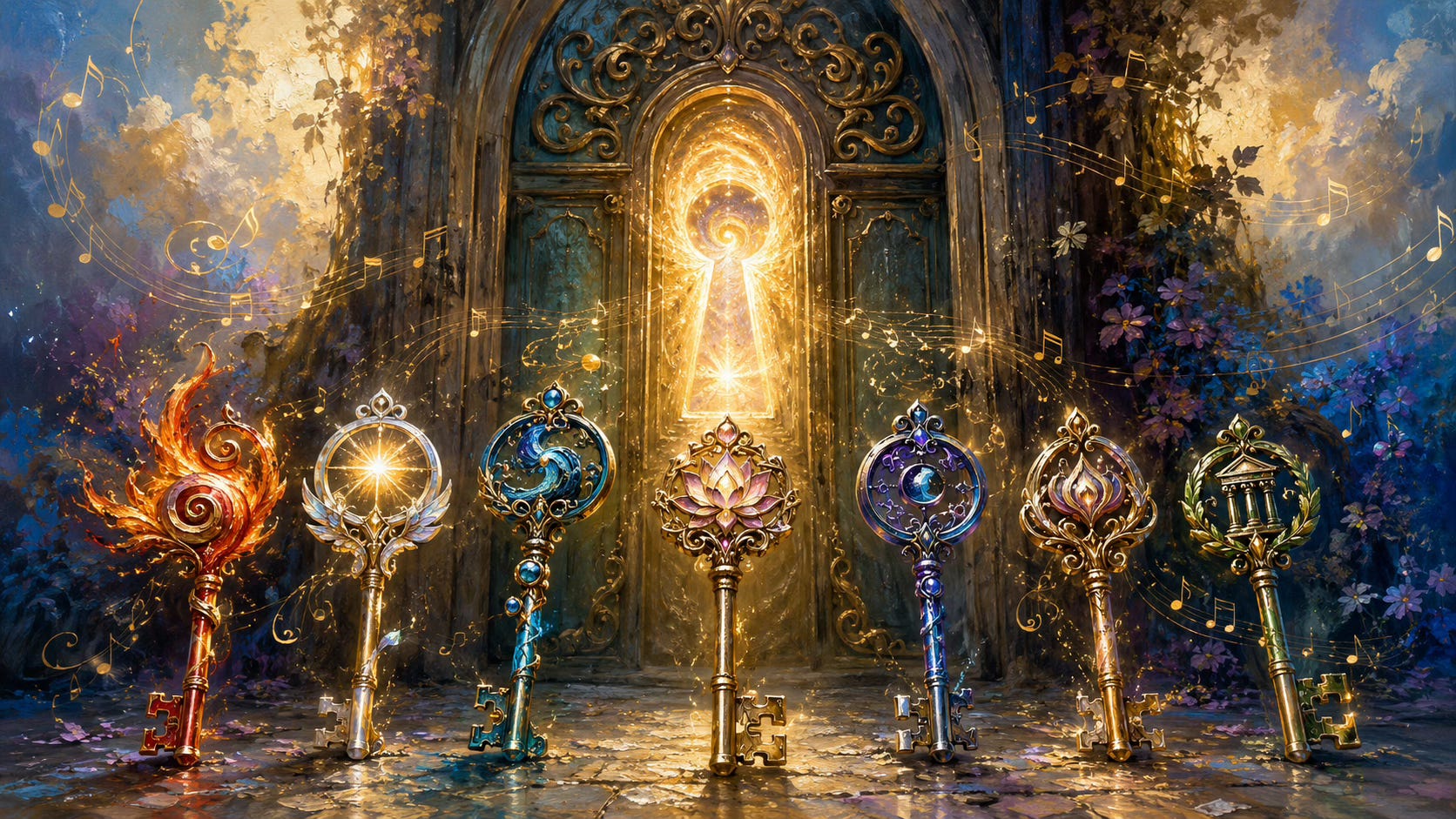
We carry all seven energies, although some feel more native, motivating and available to us than others. They aren’t personality types or fixed identities, and they don’t tell us which profession to enter or what kind of business to build. They give us a language for recognizing how our energy tends to move when we’re fully engaged. They also help us see what can happen when that energy becomes constrained or loses its natural flow.
You can read a full introduction to the EnteleKeys here. Take the free EnteleKey Reveal here to uncover yours.
In this series, I’ll be exploring them through a particular lens: how our native energies influence the way we create value and give that value form.
One person may create through illumination and guidance. Another brings something the “new” into being. Someone else awakens movement, challenges inertia, or restores coherence where life has become fragmented. Any of these energies can appear in many fields and many kinds of work.
A Helper–Enlightener doesn’t have to become a coach. A Scholar–Scientist doesn’t have to become an academic. An Aesthetic–Harmonizer doesn’t have to work in design. A Creator–Enterpriser doesn’t have to start or run a company.
The EnteleKey doesn’t determine the form. It helps reveal the energy invested in the form.
When the Business Model Doesn’t Fit
That matters because the same business model can feel liberating to one creator and deadening to another. Someone who thrives through close, attentive work may be told to build a high-volume membership because it is more scalable. A person who needs depth may feel pushed to produce daily fragments in order to remain visible. A prolific originator may imprison herself inside endless one-to-one delivery because she hasn’t created another way for her ideas to travel. A gifted guide may continue giving away her most valuable discernment because receiving money for care feels uncomfortable. From the outside, these situations can look like failures of discipline or strategy. Sometimes they are just energetic mismatches.
A business is a vessel. It can allow a creator’s energy to circulate or it can repeatedly obstruct it.
Understanding your inner economy won’t remove every difficulty. Creating something meaningful still asks us to grow. It asks us to tolerate exposure and repetition. It requires forms of labor that may not come naturally. We still have to communicate, make invitations, establish a price, organize the work and follow through.
Self-knowledge is not a substitute for execution, but execution becomes more powerful when it is rooted in a true understanding of what is being expressed. Without that understanding, creators often borrow an entire way of working along with the strategy. They adopt another person’s language, pace, offers and style of visibility. The result may be competent, but something is missing. The work begins to sound like the marketplace instead of the person.
The answer isn’t to reject expertise or assume that instinct alone will create abundance. It is to put strategy in its proper place. Strategy should serve the creator’s nature. The creator shouldn’t have to disappear in order to serve the strategy.
From Recognition to Actualization
The movement toward actualization begins with recognition. We have to understand the value we create. Not the flattering description we would like to believe, but the recurring contribution that can be observed across our lives.
What do people consistently seek from us? What becomes clearer or more possible because we are present? Where do we create movement without fully realizing that others may not be able to do it in the same way?
Then we have to communicate that value. People can’t choose what they can’t perceive. We may know what we intend, but another person needs language that helps her understand what our work could make possible.

This isn’t about reducing ourselves to a slogan. It is about becoming legible.
Value also needs a form. An idea may become an essay, a service, a product, a class, a practice, a performance, or a tool. Whatever the form, it has to become concrete enough for another person to encounter and use.
Then comes the part many creators find more difficult: we have to allow value to return.
Many of us have developed the giving side of our economy while neglecting the receiving side. We share, teach, support, make and encourage. Then we hesitate when the work must be priced or directly offered.
Money isn’t proof of worth, and not every worthy creation needs to become a business. But if we are trying to build a sustainable body of work, compensation is one of the ways value returns. It gives the creator time. It creates room for the work to continue. It can provide the support needed for something meaningful to grow beyond the limits of one person’s unpaid effort.
There is nothing noble about building work that repeatedly depletes the person who created it. An abundant exchange doesn’t ask us to become acquisitive or manipulative. It asks us to create a structure in which giving and receiving can both occur.
Before you decide what to launch, sell, publish, or build next, it may be worth pausing long enough to understand what you are actually investing.
Your ideas matter. Your experience matters. Your skills matter. But beneath them is something more enduring: a pattern through which you turn your attention, imagination, knowledge, judgment, and lived experience into value.
That pattern is part of your Inner Economy.
The work ahead is to recognize it clearly, embody it more fully, communicate it honestly, and give it forms through which it can move into the world. Then abundance becomes less about chasing every available opportunity. It becomes a practice of recognizing which opportunities can actually carry what is yours, and learning how to create them when they don’t yet exist.
What This Series Will Explore
In the essays ahead, we’ll look more closely at how creators can understand the value they already carry and begin giving it a clearer form, as they lean into execution.

We’ll return to the EnteleKeys as distinct patterns of energy and contribution. We’ll consider how those patterns may shape the way a person creates, communicates, recognizes opportunity, and builds trust. We’ll also look at what happens when a creator adopts methods that don’t suit her nature, or mistakes another person’s success formula for a path she should follow.
I believe in the innate power of the EnteleKeys and invite you to explore yours.
Some essays will explore the larger ideas behind the Creator’s Inner Economy and the Path to Abundance. Others will look through individual EnteleKey lenses and consider how different energies approach visibility, execution, growth, and exchange.
This won’t be another set of instructions to follow. It is an invitation to see yourself more clearly, so that you can make better choices about what to create, what to pursue, what to leave alone, and what kind of structure might allow your work to become more sustainable.
The aim is not to make you less open to guidance. It is to help you remain in possession of your own authority while you receive it.
That is where we’ll begin.
In Flow with You,
Angelique
