
The "Ache" Is Often "Aliveness" Trying to Return
Why the restlessness beneath a well-managed life may be pointing you toward FLOW


The Quiet Pressure Beneath a Well-Managed Life
There is a kind of ache that arrives in a life not because that life has failed, but because it has become too small for the fullness of the person living it.
It may not look dramatic from the outside. The bills are paid. The calendar is managed. The roles are intact. The work has been done, often well. Other people may see competence, generosity, achievement, dependability, even grace. They may see someone who has handled what needed handling, who has been useful, impressive, loving, composed, resilient.
And yet, beneath the surface, something begins to press.
At first, it may not have language. It shows up as restlessness. A private irritation. Fatigue that sleep does not quite repair. Emotional flatness where there used to be interest. A strange envy of people who seem more alive, more daring, more freely themselves. A grief that has no obvious object. A longing that feels almost embarrassing because, by all ordinary measures, one should be grateful.
Sometimes the ache gathers itself into a question:
Is this all?
Not because life has been empty, but because some part of the self has remained unexpressed inside it.
This is the Ache.
Not mere dissatisfaction. Not pathology. Not proof of ingratitude or immaturity. Not a failure to appreciate what one has built, survived, achieved, protected, or carried.
The Ache is often the friction between who a person had to become and what within them still longs to live more fully.
The Hidden Cost of Adaptation
For many thoughtful adults, especially in midlife or other threshold seasons, this Ache becomes difficult to ignore. The old structures may still function, but they no longer nourish. The identity that once gave shape, safety, approval, or belonging begins to feel narrow. Even the capacities that once made life work—competence, discipline, caretaking, adaptability, emotional control, strategic intelligence—may begin to reveal their hidden cost.
A person can become so good at being what life required that they lose contact with what life is asking to become through them.
This is one of the quiet sorrows of maturity. Not only that we age, lose time, or face limitation, but that we may wake to recognize how much of ourselves has lived in a state of postponement.
The singer became the organizer.
The artist became the professional.
The visionary learned to be practical.
The sensualist learned to be appropriate.
The leader learned to be agreeable.
The thinker learned to explain instead of wonder.
The child of beauty became the family’s responsible one.
The one with a wild inner weather learned to keep everything smooth, pleasant, and manageable.
Adaptation is not wrong. Often it is how we survive. It is how we belong to families, institutions, cultures, marriages, professions, and histories that may not have had room for the whole of us. Adaptation can be intelligent, even loving. It can be the body’s wisdom under pressure, the soul’s temporary shelter.
But chronic adaptation becomes costly when it hardens into identity.
Over time, we may forget that we adapted. Usefulness begins to masquerade as worth. Competence becomes a substitute for vitality. Responsibility stands in for love. Performance is mistaken for belonging. Achievement is confused with aliveness.
A life can be successful and still feel strangely unlived.
Achievement Is Not the Same as Aliveness
This is not because achievement is false. Achievement can be beautiful. Devotion to craft, family, profession, service, mastery, and excellence can be noble expressions of the self. But when achievement is severed from inner nature, it begins to feel hollow. It becomes a structure without breath. A polished room no one actually inhabits.
Aliveness is different.
It is not the same as excitement, though it may include excitement. It is not the same as productivity, though it may generate work of great power. It is not the same as happiness, though it often restores joy.
Aliveness is the felt sense that one’s inner nature has contact with one’s outer life.
It is coherence.
It is the relief of no longer living at a distance from oneself.
The Ache, then, may come as a messenger. Not to condemn the life already lived, but to reveal the dimensions of the self that have not yet been welcomed into expression.
The Many Languages of the Ache
It speaks in many ways: longing, envy, numbness, fatigue, vocational displacement, unrealized creativity, emotional constriction, loss of enthusiasm, or the subtle sense that life no longer fully fits.
Longing may arrive as a sudden tenderness toward music, color, travel, language, silence, erotic energy, study, beauty, justice, nature, sacred practice, invention, community, solitude, or voice. Something stirs, and the mind rushes to dismiss it. Too late. Too impractical. Too self-indulgent. Too strange. Too much.
Envy can be an uncomfortable teacher. Not petty comparison, but the deeper kind that points toward exiled desire. We see someone painting, writing, teaching, moving, leading, building, resting, loving, praying, dancing, traveling, speaking plainly, living with less apology, and something in us contracts. That contraction is not always resentment. Sometimes it is recognition arriving through the back door.
Numbness has its own language. A nervous system trained for years to endure, organize, anticipate, and accommodate may become less available to pleasure, imagination, and desire. One moves through the day efficiently but without savor. Food loses brightness. Conversation becomes functional. The body feels like an instrument stored in its case. There is no obvious crisis, only a low dimming of sensation.
Fatigue may carry a deeper message than effort alone can explain. There is the exhaustion of living in forms that no longer fit. The exhaustion of suppressing one’s true responses. The exhaustion of being continually reasonable when something deeper wants to be real. The exhaustion of translating oneself into acceptable shapes.
Vocational displacement can be especially disorienting when a former identity begins to loosen. The career that once conferred meaning becomes too narrow. The title no longer carries the soul. The old ambition loses heat. One may still be capable, even excellent, but the work no longer answers the deeper question: What wants to come alive through me now?
Unrealized creativity leaves a different ache: the unwritten pages, the unmade room, the unsung music, the business never built, the garden never planted, the idea that returns over decades. The desire to make something not because it will be approved, profitable, or impressive, but because it carries one’s life-force.
The psyche often signals through patterns long before the conscious mind understands them.
We repeat moods, attractions, frustrations, fantasies, complaints, irritations, and longings. Certain themes keep circling back. We are drawn again and again toward particular kinds of beauty, contribution, knowledge, intimacy, order, freedom, devotion, transformation, or expression. What looks at first like random preference may actually be clue, pattern, signal.
A trace of the architecture of our aliveness.
We Are Not One-Note Songs
We are coherent, moving compositions.
There are many forms of life within a life: the part that loves to serve and the part that longs to be seen; the part that wants harmony and the part that wants truth; the part that carries wisdom and the part that wants to experiment; the part that builds structure and the part that must wander; the part that protects, creates, studies, beautifies, liberates, heals, reforms, and devotes itself to what it loves.

A person may have lived for years from only one register of the self because that register was rewarded, required, or safest. The responsible one. The brilliant one. The helpful one. The composed one. The productive one. The agreeable one. The strong one.
But the rest of the composition does not disappear.
It waits.
In the body. In fantasy. In grief.
In a sudden devotion to a new subject. In the ache that rises when the house becomes quiet, the children leave, the career shifts, the marriage changes, the caregiving ends, the old ambition cools, or the soul simply refuses to keep living on terms that once ensured survival.
The Chrysalis Season
This is why the Ache is developmental as much as psychological.
It belongs to the unfolding of a life. It appears when an earlier adaptation has completed its usefulness, or when a former identity can no longer hold the whole person. It asks for more than symptom management, though tenderness toward symptoms may be necessary. It asks for attention to emergence.
There is a reason many thresholds feel less like improvement and more like disassembly. In nature, transformation is rarely neat. The caterpillar does not become a butterfly by becoming a more disciplined caterpillar. It does not effort itself into wings. It enters the chrysalis, and the old form begins to dissolve. What once crawled, consumed, and moved close to the ground becomes something almost unrecognizable before a new coherence can organize itself from within.
This is not a sentimental image. It is a severe and beautiful one.
The caterpillar must lose the form that once made sense. Its former way of moving through the world cannot carry the life that is next. Inside the chrysalis, the creature enters a state that looks, from one level of perception, like undoing. But within that apparent undoing, imaginal cells begin to carry the pattern of the butterfly.
I have always loved that phrase: imaginal cells.
It sounds like poetry, but it also gives us an image for a truth we can feel in our own lives. Long before we consciously understand what is changing, some deeper intelligence may already be carrying the blueprint of emergence.
Small signals appear.
A longing.
A grief.
A fascination.
A recurring image..
A sudden refusal.
A tenderness toward something we once dismissed.
A growing discomfort with what used to be tolerable.
These may be our imaginal signals.
At first, they can feel disruptive. The old identity may experience them as a threat. Of course it does. Every established self has a certain allegiance to continuity. It wants to keep the form intact. It wants to preserve the agreements, roles, rhythms, and loyalties that once made life recognizable.
But the next form of aliveness rarely arrives with a full map. It begins as pressure, signal — an Ache.
Many human transitions carry this same mystery. A life that once seemed solid begins to lose its shape. Former motivations thin out. Old identities soften. The self one has relied upon no longer feels sufficient, yet the next form of life has not fully arrived. This in-between can feel like confusion, fatigue, failure, or even a kind of private madness.
But it may be closer to metamorphosis than collapse.
The road to aliveness is not always a straight ascent. Sometimes it asks for a trusting surrender to the chrysalis: the season in which the old structure loosens, the psyche reorganizes, and something truer begins to take form.
The Ache often belongs to that passage. It is the signal that the old way of being can no longer contain the life pressing to emerge.
Something is trying to become conscious.
Something is trying to return.
Something is trying to move from suppression into form.
Something is begging to collapse and regenerate into something newer.
FLOW as Inner and Outer Coherence
This is where FLOW (Fully Living your Own Way) begins to matter.
FLOW is not a mood of constant ease. It is not the fantasy of a life without friction. It is the increasing coherence between inner nature and outer life. As we begin to notice where our energy contracts, where it opens, where it has been overused, where it has been abandoned, where it has been borrowed from old expectations rather than sourced from living truth, we can begin to move differently.

To move toward FLOW is to become more honest about the relationship between identity and essence.
Identity is often built in response to the world. Family systems, culture, profession, education, survival, approval, injury, duty, opportunity, and fear all leave their marks. Essence is deeper. Not a fixed personality, but the animating pattern of one’s being—the way life moves through a person when it is less distorted by compulsion, fear, or excessive adaptation.
The Ache often emerges when identity and essence are no longer in sufficient conversation. At such moments, the task is not to discard one’s life in a dramatic gesture. It is not to romanticize disruption or mistake intensity for truth. The beginning is quieter than that.
Recognition.
Observation.
A willingness to notice.
Where do I feel most alive?
Where do I feel most diminished?
What part of me has been praised into overuse?
What part of me has been neglected because it did not serve the role I was assigned?
What do I keep longing for, even after I have explained it away?
Where has usefulness replaced desire?
Where has competence replaced wonder?
Where has responsibility become a hiding place from my own becoming?
These questions do not demand immediate answers. In fact, they may resist answers that come too quickly. The deeper psyche often requires a more spacious attention. It reveals itself through images, patterns, bodily responses, repeated attractions, old griefs, and new hungers.
The EnteleKeys as Patterns of Aliveness
This is also a gentle doorway into the EnteleKeys.

The EnteleKeys are not meant to reduce a person to a type. They are not labels to wear or boxes to occupy.
The EnteleKeys offer a way of perceiving recurring energetic patterns—patterns through which aliveness expresses itself, becomes overdeveloped, becomes suppressed, becomes distorted, or begins to return.
A natural wisdom pattern may become trapped in usefulness. Creative power may be postponed in the name of practicality. A love of beauty may be treated as decoration rather than intelligence. The capacity for order may harden into control. Devotion may be given away before it is rooted in one’s own values. A hunger for liberation may be muted into compliance. Insight may remain private, unoffered, or untrusted.
Each EnteleKey carries its own form of energetic Ache when its natural current is blocked, overused, exiled, or forced to serve survival rather than aliveness. Each also carries a movement toward FLOW, where the pattern becomes more coherent, generous, vital, and true.
The Dynamo-Liberator may ache when its hunger for freedom, movement, courage, and fresh possibility is muted into compliance or scattered into restless escape. In FLOW, this pattern becomes catalytic vitality: the power to break stagnation, enliven what has gone dull, and move life toward a more liberated form.
The Helper-Enlightener may ache when wisdom, care, and guidance become trapped in usefulness, over-responsibility, or the need to be needed. In FLOW, this pattern becomes luminous discernment: the capacity to serve, teach, illuminate, and uplift without abandoning the self.
The Creator-Enterpriser may ache when creative intelligence is postponed in the name of practicality, buried beneath duty, or reduced to productivity without soul. In FLOW, this pattern becomes generative manifestation: the ability to imagine, build, initiate, and bring something original into form.
The Aesthetic-Harmonizer may ache when beauty, sensitivity, sensual intelligence, and relational attunement are dismissed as decoration or absorbed into people-pleasing. In FLOW, this pattern becomes embodied harmony: the capacity to restore beauty, proportion, feeling, and grace to the inner and outer world.
The Scholar-Scientist may ache when insight remains private, over-intellectualized, un-offered, or severed from lived meaning. In FLOW, this pattern becomes clarifying intelligence: the devotion to truth, inquiry, pattern, and understanding in service of a more conscious life.
The Idealist-Devotee may ache when devotion is given away before it is rooted in one’s own beliefs, values, ideals, and sacred yes. In FLOW, this pattern becomes ardent alignment: the power to live, love, choose, and contribute from what one truly reveres.
The Manager-Reformer may ache when the capacity for order, responsibility, and improvement hardens into control, perfectionism, or moral burden. In FLOW, this pattern becomes wise stewardship: the ability to organize life, repair what is broken, and shape systems that serve wholeness rather than fear.
Seen this way, the EnteleKeys are less about identifying “what you are” and more about noticing how aliveness moves through you. Where has it been narrowed? Where has it been praised into overuse? Where has it been hidden because the world did not know how to receive it? Where is it now trying to return?
To recognize the pattern is not to solve the life. It is to begin seeing it more truthfully.
And truth, when received with compassion, has movement inside it.
Listening Before Leaping
Many people come to a threshold believing they need a new plan. Sometimes they do. But often, before the plan, they need a new intimacy with their own signals. Longing is not foolish. Envy is not only shameful. Fatigue is not always laziness. Numbness is not failure. Restlessness is not necessarily a problem to be disciplined away.

These signals may carry intelligence. Together, they may form part of the Ache.
And the Ache may be saying:
There is more beauty in you than your life currently permits.
More imagination than your schedule can hold.
More truth than your role allows you to speak.
More tenderness than your competence has had room to feel.
More desire than your identity has allowed you to claim.
More contribution than your current form of usefulness can express.
More Life.
The beginning of transformation is not always a leap. Sometimes, it is the first honest naming of what has gone quiet.
A person notices that the body softens when they speak about a dream they had nearly abandoned. Energy returns in a bookstore, a studio, a garden, a classroom, a sacred space, a difficult conversation, a new field of study. Irritation reveals itself as grief. Exhaustion begins to look less like weakness and more like misalignment. What once seemed like discontent starts to feel like the soul asking for a larger room.
This recognition does not erase duty, history, limitation, or complexity. We still live inside bodies, families, economies, obligations, and consequences. But even within real constraint, aliveness can begin to find openings.
A conversation becomes more honest.
A room is rearranged.
A class is taken.
A boundary is spoken.
A morning practice begins.
A hidden project receives one hour of devotion.
A relationship is re-imagined
A desire is allowed to exist without requiring permission.
A person begins to observe the pattern instead of being unconsciously governed by it.
The Ache as Compass
Slowly, the Ache changes character. It becomes less like a wound and more like a compass. Less like indictment and more like invitation.
It may still hurt. Birth often does. Metamorphosis does too. But the hurt is no longer meaningless. Like the butterfly, it belongs to the reorganization of a life around a deeper coherence.
There are seasons when the self must adapt in order to survive. There are seasons when the self must awaken from its adaptations in order to live.
The Ache often marks the crossing between the two.

It asks us to become curious about the life beneath the life. The one waiting inside competence, beneath caretaking, beyond performance, under the polished surfaces of success or responsibility. It asks us to recover the tones we silenced, the colors we muted, the questions we deferred, and the forms of contribution that cannot arise from obligation alone.
It asks us to remember that we are not here merely to function.
We are here to become more fully inhabited.
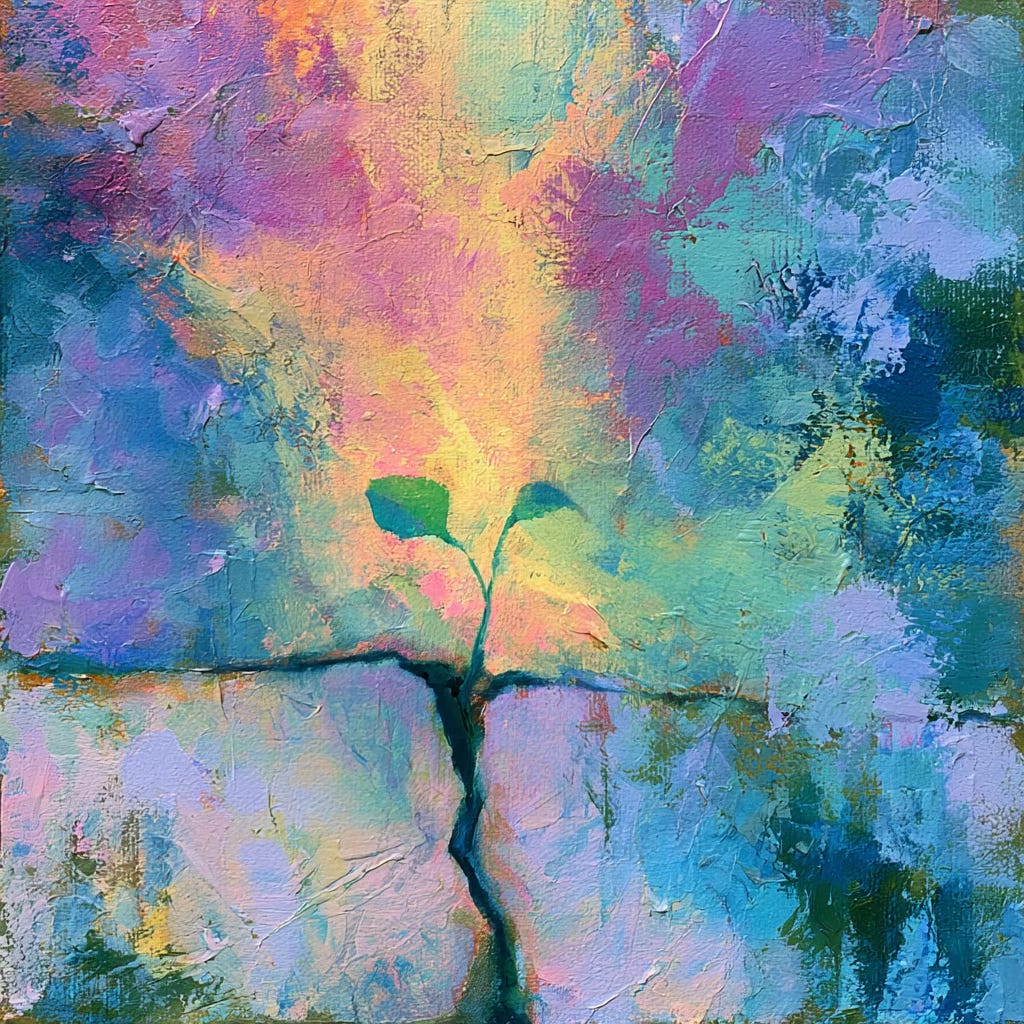
And…perhaps the Ache, when approached with reverence rather than fear, is one of the first signs that the deeper self has not abandoned us. It is still signaling. Still pressing. Still sending up green shoots through the pavement of the life we learned to maintain.
The Ache may be aliveness trying to return.
It may be the first tremor of FLOW.
It may be the imaginal signal of a life preparing to take a truer form.
Not all at once. Not by force. Not by becoming a better version of the old self - but by allowing the many notes of the Self to gather again, slowly and with care, into a more honest composition.
A life no longer forced into one acceptable melody.
A Life becoming Music.
Take the first step and explore your EnteleKeys.
In Flow with You,
Angelique

Maureen, I really appreciate your response…I hope you share more…another kindred soul!
Angelique I don't even know where to begin
This is so profound to me
I cannot put my thoughts together well enough to express how real this was for me Sometimes it helps when it's labeled, when it has a name! Gonna sit with it for a bit