
Feeling Stalled or Directionless? You’re Likely Moving Against Your Own Energy
An Invitation to Understand your own Energetic Blueprint That Moves You Toward FLOW


About My Journey and Why this Post
As a youngster, I was a creative by nature—drawn to ideas, expression, and possibility—but the career path I followed was shaped by a different kind of logic. At the time, law school presented itself as a highly rational and compelling opportunity. It was positioned as something rigorous, expansive, and difficult to walk away from—“a door you don’t close lightly.” The joint degree with business followed from similar reasoning. It made sense. It added range. It felt like the kind of decision you make when you are trying to keep your options open while still moving forward.
And so I said yes, step by step, to a path that was entirely reasonable and safe.
It led to roles in law firms and then in corporations—all focused on some aspect of business development — work that was structured, demanding, lifestyle-challenging and intellectually engaging in its own way. I was capable of doing it well, and from the outside, the trajectory held together.

And yet, something never quite settled.
I could do the work. I could succeed within it. But sustaining energy for it required a kind of effort that felt disproportionate. At the same time, there were other directions—less defined, less certain—that seemed to generate energy almost immediately.
For a long time, I interpreted this as inconsistency. Confusion. Lacking direction. I assumed I needed to be more focused, more disciplined, more committed to a single path. But the more I paid attention, the more I realized the issue wasn’t a lack of effort.
It was a lack of alignment.
I didn’t yet understand why certain activities and directions energized me, while others—equally valid on paper—did not. I came to understand I wasn’t alone and began my own project of what could help me. The popular self-assessments (Myers-Briggs, DISC, Enneagram, Holland, etc.) did not hit the mark for me. Based on alot of my own research into purpose and meaning, I ended up creating the “EnteleKeys” and began to work with them, and then with others feeling what I was feeling.
Over time, for me, something important shifted. As I began to understand my EnteleKey patterns more clearly, I stopped trying to entirely exit the path I was on and started to navigate it differently. I was invested deeply into my career after years of schooling and roles.
What changed was this: I began making more conscious choices—selecting roles, matters, and directions within my legal career that better reflected my natural strengths and what genuinely motivated me.
What had felt like a misalignment became, gradually, something I could work with, and still realize my natural gifts and talents that energized me. My career did not disappear—it evolved. By the time I retired, I could look back and see it as a worthwhile and meaningful journey, one that had been reshaped through a more conscious understanding of how I was designed to move. The EnteleKeys did not take me out of that world. They gave me a compass within it—and they continue to guide and refine my choices even now in this post-career phase. I noticed a shift in my EnteleKey pattern and it has brought me here.
So yes, the EnteleKeys emerged from my own journey. And what they revealed is what we’re beginning to explore here:
Why you can feel pulled in different directions— and why that experience may have far more intelligence in it than you’ve been led to believe.
When Your Motivation Doesn’t Match the Path You’re On
There are moments when it is not confusion that troubles you, but a quieter, more persistent experience: a lack of energy for what you believe you should want.
You may be in a role that looks right on paper, one that others respect or even admire, and yet it takes effort to stay engaged. You begin things with intention, but the momentum fades. What once seemed like a good decision starts to feel heavy, or simply uninteresting in a way you cannot fully explain.
Or you may notice a different pattern. There are certain activities, ideas, or directions that immediately draw you in. You do not have to force yourself toward them. Your attention sharpens, your energy increases, and time seems to organize itself differently around them. Yet these are not always the paths you have been told to prioritize, or the ones that feel most practical or responsible.
The tension between these two experiences—what you are drawn toward, and what you believe you should pursue—often shows up as feeling pulled in different directions.
But the pull is not random. It is directional.
When You’re Drawn to More Than One Path
There is another experience that often goes unnamed, particularly for those who have always felt drawn to more than one path.
If you have been described as “multi-passionate,” you may also have been quietly judged for it. You may have been encouraged to narrow your focus, to choose one direction, to prove your seriousness by committing to a single lane.
Over time, this can create a subtle form of self-doubt. You begin to question whether your breadth of interest is a strength or a liability. You may wonder if the reason you have not settled into a clear direction is because you lack discipline, clarity, or follow-through.
But what if that interpretation is incomplete?

What if your experience of being drawn in multiple directions is not a failure to choose, but a reflection of how your energy is designed to move?
In the EnteleKeys framework, it is entirely natural to have more than one energized direction. While certain EnteleKeys may lead more consistently, others remain active and available, shaping what you are drawn toward and how you engage with it.
This means that what appears as “too many interests” can, in reality, be a coherent pattern of multiple energies seeking expression.
The difficulty arises not from having multiple directions, but from trying to force them into a model that assumes there should only be one.
When you begin to understand your EnteleKeys, this experience starts to reorganize itself. Instead of seeing your interests as scattered, you begin to see how they relate—how one energy initiates, another refines, another brings meaning, and another sustains.
What once felt like fragmentation begins to reveal an underlying structure.
The Frustration of Misdirected Effort
For many people, this tension becomes most visible through patterns like these:
You commit to a path that makes sense—professionally, financially, or socially—but find yourself repeatedly losing motivation, procrastinating, or disengaging over time.
You push yourself to follow through on something you chose deliberately, yet it feels effortful in a way that does not match your expectations of what “alignment” should feel like.
You look at others who seem energized by what they are doing and wonder why similar paths do not produce the same effect for you.
You generate interest in multiple directions, but when it comes time to commit, something in you withdraws—not out of fear, but out of a lack of genuine pull.
You tell yourself that you simply need more discipline, more focus, or more consistency, and yet increasing effort does not reliably increase motivation.
Over time, this can begin to feel like a problem of directionlessness.
But what is often underneath it is something more precise: a misalignment between what you are pursuing and what actually generates energy for you.
Why “Should” Often Fails
Much of what creates frustration in decision-making comes from relying on externally derived “shoulds.”
You may choose a direction because it is stable, respected, or widely recommended. You may pursue something because it aligns with a version of success you have internalized over time.
But if that direction does not correspond with your underlying energetic design, it will require disproportionate effort to sustain.
This is where people often become confused. They interpret the drop in motivation as a personal failure, rather than as feedback about the fit between themselves and the path they have chosen.
The issue is not a lack of willpower.
It is a mismatch in directional alignment.
Recognizing What Actually Generates Energy
When you begin to understand your EnteleKeys, you start to see a different pattern emerge.
You notice that certain kinds of work, environments, or ways of engaging consistently generate energy for you, even when they are challenging. You also notice that other directions, while manageable in the short term, do not sustain your interest or momentum over time.
This does not mean you avoid everything that feels difficult. It means you begin to distinguish between what is effortful because it is growth, and what is effortful because it is misaligned.
That distinction is critical. Because it is the difference between building something that deepens your sense of meaning, and continually pushing yourself through paths that deplete it.
The Connection to Meaning and Purpose (MaP)
What you experience as Meaning and Purpose is not an abstract concept that exists outside of your daily life. It is expressed through the directions you are naturally drawn toward, and the forms of engagement that sustain your energy over time.
Your MaP is not something you invent.

It is something you locate—by recognizing where your energy consistently moves, and where it does not.
The EnteleKeys provide a way to map that movement.
They help you see why certain directions feel compelling, why others feel draining, and how your particular configuration of energies shapes the kinds of paths that will be most coherent for you to walk.
What the EnteleKeys Clarify
The EnteleKeys framework is designed to make this distinction visible.
At its core, it is not a system of behavior. It is a system of motivation and directional flow.
Each EnteleKey represents a distinct way in which energy moves through you—what draws your attention, what sustains your engagement, and what creates a sense of rightness in your actions.
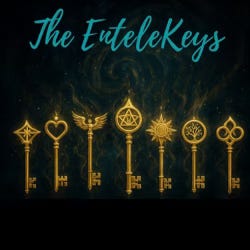
Some of these energies feel naturally compelling. When you are operating within them, effort tends to organize itself more easily. There is a sense of movement that does not rely on constant force.
Others may feel neutral, or even draining when over-relied upon. They are not “wrong,” but they do not generate the same level of intrinsic energy for you.
Without a framework like this, it is easy to assume that all directions should feel equally viable if they are logically sound or externally validated.
But they are not.
A More Useful Question
Instead of asking, “Why can’t I stay motivated?” — you begin to ask a different question:
“Is this direction actually aligned with how my energy is designed to move?”
That shift alone changes how you evaluate your choices. It moves you away from self-criticism and toward discernment.
The MaP Within Each EnteleKey
Each EnteleKey carries its own orientation toward Meaning and Purpose—its own way of answering the question: What makes life feel worth living?
While all seven live within you, each expresses MaP differently:
Dynamo – Liberator
Is drawn toward movement, breakthrough, and the release of constraint. Meaning emerges through action, momentum, and the ability to initiate change.
Helper – Enlightener
Is drawn toward connection, care, and the enlightenment and upliftment of others. Meaning emerges through responsiveness, generosity, and the ability to bring light and clarity to another’s experience.
Creator – Enterpriser (Generative)
Is drawn toward building, imagining, and bringing something new into form. Meaning emerges through creation, innovation, and the realization of possibility.
Aesthetic – Harmonizer
Is drawn toward beauty, resonance, and emotional truth. Meaning emerges through expression, refinement of experience, and the creation of coherence where there was discord.
Scholar – Scientist
Is drawn toward understanding, inquiry, and precision. Meaning emerges through clarity, truth-seeking, and the deepening of knowledge.
Idealist – Devotee
Is drawn toward values, purpose, and what ultimately matters. Meaning emerges through devotion, alignment, and living in accordance with deeply held truths.
Manager – Reformer
Is drawn toward order, improvement, and responsible stewardship. Meaning emerges through structure, refinement, and the creation of systems that work.
Each of these is a valid expression of MaP. The question is not which one is “better,” but which ones are most alive within you—and how they work together.
An Invitation
If something in this resonates—if you recognize the pattern of being drawn toward certain directions while struggling to sustain others—it may be worth seeing your own configuration more clearly.
The EnteleKey Reveal Assessment offers a way to do that. It does not tell you who to become. It reflects how your energy is already organized—what draws you forward, what sustains you, and what may be quietly depleting you when followed for too long. Upon completing the assessment, you will receive an extensive report which will reveal your EnteleKey pattern, your leading and least preferred EnteleKeys and what they mean, in addition to useful information about all of the other EnteleKeys.
For many, this is the point where direction begins to feel less like something that must be forced, and more like something that can be understood and trusted.
What Comes Next
In the next post, we will look more closely at the seven EnteleKeys and you can experience your own resonance!
In Flow with You,
Angelique
